Design fabric for use and reuse
While circular fashion is a favored concept for those seeking
sustainability, it stands independent of other attempts at
eco-friendly fashion manufacturing. Rather than creating
garments that just happen to be recyclable, circular fashion
intentionally employs textiles and fabrics that are designed,
sourced, produced, and transformed specifically to be reused
and recirculated for as long as possible. Circular fashion has
economic benefits beyond standard sustainability efforts, as it
reduces dependency on raw imported materials, while
restructuring the fashion economy. Circular fashion is opening
new markets within the industry and making way for a new
system of innovation.
Transitioning from fast fashion—or even from legacy methods of
sustainable fashion—to circular fashion requires operational
transformation; but it has the potential to pave new pathways
to economic growth.
The Ellen MacArthur Foundation estimates that circular
fashion has the potential to unlock a $560 billion economic
opportunity. This opportunity, however, can only be pursued by
those fashion manufacturers and retailers that are willing to
evolve and pivot towards new business models and inputs that
significantly increase garment usability and lifespan.
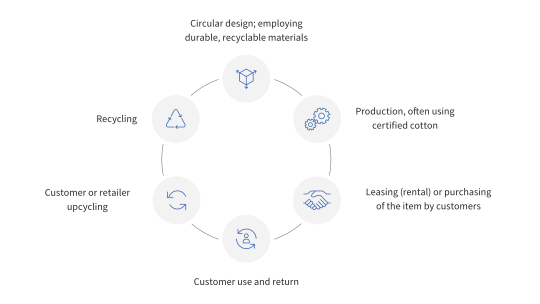
The “wheel” of circular fashion, represents the cyclical nature of
the model and each of its phases:
- Circular design; employing durable, recyclable materials
- Production, often using certified cotton
- Leasing (rental) or purchasing of the item by customers
- Customer use and return
- Customer or retailer upcycling
- Recycling
The “wheel” of circular fashion
Work with customers to sustain the new value chain
There’s more to circular fashion than the development of
textiles and reusable materials. The system engages every
segment of the value chain, beginning and ending with the
customer. Though circular fashion was developed in response
to customer demand and interests, customers need to uphold
their investment in sustainability from inception to execution.
Manufacturers and retailers can commit to the development of
strong, reusable materials, but it’s up to customers to extend
the life of the finished products.
In the US, clothes are typically discarded well before the life of
the garment has concluded, racking up $460 billion in waste.
The excess of waste contributes to a massive footprint that
could easily be halted. Rather than discarding garments,
circular fashion promotes a shift in business models—one that encourages clothing rentals, thrifting, reselling,
and the production of circular collections. This trend is
disrupting the value chain, pushing fashion companies and
customers to work together in different ways to utilize clothing
to its fullest potential.
Fashion companies are creating new, regenerative business
models that increase clothing usage without damaging the
bottom line. By using fewer resources, such as water,
manufacturers will experience cost benefits. These savings,
coupled with a higher cost-per-garment, can help offset
expenses that come with sustainable transformation. The
higher quality of the fabrics and clothing and the longer lifespan
can help justify higher costs to the consumer. To communicate
this value to customers, businesses need to collaborate with all
facets of their business, from production to marketing and
post-sale customer care.
Create value in durability
Reframing consumers’ perception of clothing items to durable,
valuable goods is not an easy feat, but many manufacturers
have already gained a competitive edge by opening new lines to
consumers. Tefron, the renowned intimate apparel contract
manufacturer, took major strides toward a circular fashion
marketplace by improving production techniques and the engineering of fabrics to ensure maximum recyclability.
By reinforcing the structure of these clothing items,
manufacturers like Tefron set customers up for success
with the reuse and recycling of fabrics.
There’s ample opportunity for innovation and creativity in the
burgeoning circular fashion market. One Swedish clothing-retail
company will pay customers $5 for every bag of clothing
brought into stores for recycling. This incentivizes customers to
perpetuate the life cycle of a garment while resupplying the
retailer with fabrics for future development.
Another Swedish leader in the fashion industry, Nudie Jeans,
expanded its services to include repairs. This encourages
customers to bring their jeans in for repair, instead of
throwing them out and purchasing new ones. This inventive
purchase-repair-reuse model appears to be working for the
fashion brand, which recently announced its goal of reducing scope 1 and 2 GHG emission by 51% to 2030. Nudie Jeans has also opened up a
marketplace for reused jeans on its online store. These
garments meet Swedish standards for the “Good Environmental
Choice” eco-designation.
Create new market opportunities
There’s potential for a high level of profitability for those fashion
companies willing to adopt new manufacturing and retail
processes. Circular fashion methodologies contribute to a
circular economy, a model that researchers suggest is not only
beneficial to the planet, but to the longevity of the fashion
business. Circular fashion has the lowest rate of depreciation relative to other clothing modalities. The fibers,
textiles, and fabrics are designed to maintain their value, if not
increase it, through initial use and later through reentry into the
economy.
Recirculating clothing reduces the cost of apparel production
and opens several new market opportunities for fashion
companies that feed into other industries to support a healthy
supply chain. For instance, clothing rentals is an area of
expressed interest for companies looking to capitalize on
circular fashion.
Rental models offer flexibility through:
- Short term—Addresses fast fashion and caters to the
changing needs of customers
- Long term—Extended rentals offer staples to certain
demographics, as well as an increased demand for seasonal
and annual rentals
- Subscription services—Can easily be categorized from baby
clothing to professional attire and can be used to address
clothing needs in modifiable intervals
Beyond clothing rentals, circular fashion makes clothing resale
more appealing to customers and retailers. According to the 2023 ThredUp resale report, the global secondhand market is expected to nearly double by 2027, reaching $350 Billion.” Customers can put their worn pieces back into
matriculation via thrift stores or find fashion companies such as
Nudie Jeans who take back their used clothing for resale.
Brands can adapt to develop trade-in programs for their
garments, further incentivizing customers to recycle their items
while generating repeat business and brand loyalty.
Ensure sustainability is sustainable
In addition to the advantages of adopting a circular fashion
model, it also comes with a set of challenges. Circular fashion is
gaining momentum, but early adopters will need to ensure their
processes can align with a more sustainable model. This means
that inventory tracking, sourcing, manufacturing, and sales
need to be properly monitored, preferably in real time.
Maintaining visibility on new and reused product influx and
production will invariably complicate the supply chain and
channels to market.
There’s also a heavy reliance on customer behavior; though this
is something the fashion industry has always grappled with.
Fashion companies must look for innovative ways to engage
customers and encourage them to follow through the cycle—
whether that be through trade-in collaboration policies,
exchanges, or repair services. Circular fashion challenges
brands to reframe the way they categorize materials, as it
calls for the integration of materials from their raw form to their
true expiration date after they’ve made several orbits around
the “wheel.“
Reevaluate internal processes
To gain a competitive edge, fashion companies need to look
for more ways to meet the needs of conscientious consumers.
Customer behaviors are constantly shifting, but modern
consumers are steadfast in their desire for more sustainability in
their clothing and in how clothing brands operate. Fashion
companies should assess current business processes to identify
where the most resources are used, where the most waste is
present, and which substances or materials contribute to the
highest volume of pollution.
Fashion companies also need to work with vendors or suppliers
to optimize energy usage and eliminate waste. Even if this isn’t
feasible, fashion companies should still consider offering
customers an exchange program to reabsorb unwanted
clothing. Once the materials have been collected, it’s easy to
repurpose them for another collection and extend their lifespan.
As long as the journey is fueled by responsibility, sustainability,
and forward-thinking, getting started can be an incremental
process. Awareness and visibility go a long way when it comes
to business transformation.